Parker Colorado Real Estate News

As Parker Colorado Realtors for the last 20 years, we've stayed on top of Parker's real estate scene. One of our main goals is to provide the homebuying and home selling public with current and worthwhile information about the real estate market here in Parker, Colorado and the surrounding communities. Hopefully, you will find our real estate news helpful.

June 15, 2023

Why Buying or Selling a Home Helps the Economy and Your Community

This is an interesting article regarding the economic impact of real estate.  I don't really have anything to add to it.  Enjoy.  And, please don't forget that Cheryl and I are ready and able to help you with any real estate needs that you may have here in Parker, Colorado and the Denver Metro Area. Call me at 720.220.5058 or Cheryl at 303.91.739.

Why Buying or Selling a Home Helps the Economy and Your Community


If you're thinking about buying or selling a house, it's important to know that it doesn't just affect your life, but also your community.

The National Association of Realtors (NAR) releases a report every year to show how much economic activity is generated by home sales. The chart below illustrates that impact:

As the visual shows, when a house is sold, it can make a big difference in the local economy. The impact comes largely from the workers required to build, update, and buy and sell homes. Robert Dietz, Chief Economist at the National Association of Home Builders (NAHB), explains how the housing industry adds jobs to a community:

The economic impact means housing is a significant job creator. In fact, for every single-family home built, enough economic activity is generated to sustain three full-time jobs for a year, per NAHB research. . . . And one job for every $100,000 in remodeling spending.” 

Housing being a major job creator makes sense when you consider there are many different industries involved in the process. A recent article from Fortune notes housing activity could have a more robust impact than you think due to the many ways it’s tied to the economy:

“Housing has three direct linkages to economic activity (GDP): the construction of new homes, the remodeling of existing homes, and that of housing transactions. . . . consider the activity associated with home sales – think broker fees, lawyers, etc. – which are a sizable contributor to housing’s GDP footprint. 

When you buy or sell a home, you work with a team of professionals, including contractors, specialists, lawyers, and city officials. Each person plays a role in making the transaction happen. 

So, when you make a move in the housing market, you're not just meeting your own needs, you're also making a positive impact on the community. Knowing this can give you a sense of empowerment as you make your decision this year.

Bottom Line

Each and every home sale is important for the local economy. If you’re ready to move, let’s connect. It won’t just change your life – it’ll also have a strong positive effect on the whole community.

Posted in Parker Real Estate
June 14, 2023

Equity Is Still "Sky High"

I don't really have anything to say or add to this article.  Basically, it's reminding us that even though home prices have gone down a bit from the highs of 2021 and 2022, they are still "sky high". 

A Drop in Equity Doesn’t Mean Low Equity


You may see media coverage talking about a drop in homeowner equity. What’s important to understand is that equity is tied closely to home values. So, when home prices appreciate, you can expect equity to grow. And when home prices decline, equity does too. Here’s how this has played out recently. 

Home prices rose rapidly during the ‘unicorn’ years. That gave homeowners a considerable equity boost. But those ‘unicorn’ years couldn’t last forever. The market had to moderate at some point, and that’s what we saw last fall and winter. 

As home prices dropped slightly in the back half of 2022, equity was impacted. Based on the most recent report from CoreLogic, there was a 0.7% dip in homeowner equity over the last year. However, the headlines reporting on that change aren’t painting the whole picture. The reality is, while home price depreciation during the second half of last year caused equity to drop, the data shows homeowners still have near record amounts of equity

The graph below helps illustrate this point by looking at the total amount of tappable equity in this country going all the way back to 2005. Tappable equity is the amount of equity available for homeowners to access before hitting a maximum 80% loan-to-value ratio (LTV). As the data shows, there was a significant equity boost during the ‘unicorn’ years as home prices rapidly appreciated (see the pink in the graph below).

But here’s what’s key to realize – even though there’s been a small dip, total homeowner equity is still much higher than it was before the ‘unicorn’ years.

And there’s more good news. Recent home price reports show the worst home price declines are behind us, and prices have started to go up again. As Selma Hepp, Chief Economist at CoreLogic, explains:

“Home equity trends closely follow home price changes. As a result, while the average amount of equity declined from a year ago, it increased from the fourth quarter of 2022, as monthly home prices growth accelerated in early 2023.” 

The last part of that quote is particularly important and is the piece of the puzzle the news is leaving out. To further emphasize the positive turn we’re already seeing, experts say home prices are forecast to appreciate at a more normal rate over the next year. In the same report, Hepp puts it this way:

The average U.S. homeowner now has more than $274,000 in equity – up significantly from $182,000 before the pandemic. Also, while homeowners in some areas of the country who bought a property last spring have no equity as a result of price losses, forecasted home price appreciation over the next year should help many borrowers regain some of that lost equity.”

And even though Odeta Kushi, Deputy Chief Economist at First American, references a slightly different number, Kushi further validates the fact that homeowners have a lot of equity right now: 

“Homeowners today have an average of $302,000 in equity in their homes.”

That means if you’ve owned your home for a few years, you likely still have way more equity than you did before the ‘unicorn’ years. And if you’ve owned your home for a year or less, the forecast for more typical price appreciation over the next year should mean your equity is already on the way back up.

Bottom Line

Context is everything when looking at headlines. While homeowner equity dropped some from last year, it’s still near all-time highs. Let’s connect so you can get the answers you deserve from an expert who’s here to help as you plan your move this year.

Posted in Parker Real Estate
June 13, 2023

Should Your Existing Mortgage Rate On Your Home Keep You From Moving?

Should Your Existing Mortgage Rate On Your Home Keep You From Moving?

That depends. This article makes the case that there are some issues/circumstances that are more important than your current mortgage rate. One of the main reasons (probably the main reason) that we have such a low inventory of homes here in Parker, Colorado is what we call "rate locked" homeowners. Those people who have current rates of 2% to 3%. They are finding it hard to justify going from those rates to 51/2% to 6%. It takes a compelling reason. This article talks about some of those reasons.

Your Needs Matter More Than Today’s Mortgage Rates


If you’re thinking about selling your Parker, Colorado house right now, chances are it’s because something in your life has changed. And, while things like mortgage rates are a key part of your decision on what you’ll buy next, it’s important to not lose sight of the reason you want to make a change in the first place.

It’s true mortgage rates have climbed from the record lows we saw in recent years, and that has an impact on affordability. With rates where they are right now, some homeowners are deciding they’ll wait to sell because they don’t want to move and have a higher mortgage rate on their next home. As Danielle Hale, Chief Economist at Realtor.com, explains:

“. . . homeowners who locked in a 30-year fixed rate in the 2-3% range don't necessarily want to give that up in exchange for a rate in the 6-7% range.”

But your lifestyle and your changing needs should matter more. Here are a few of the most common reasons people choose to sell today. Any one of these may be more important than keeping your current mortgage rate.

As Ali Wolf, Chief Economist at Zonda, says in a recent tweet:

“First-time and move-up buyers are both active . . . the latter driven by life changes. Divorce, marriage, new higher paid job, and existing home unsuitable all referenced.” 
Relocation

Some of the things that can motivate a move to a new area include changing jobs, a desire to be closer to friends and loved ones, wanting to live in a dream location, or just looking for a change in scenery. 

For example, if you live in suburbia and just landed your dream job in NYC, you may be thinking about selling your current home and moving to the city for work. 

Upgrading

Many homeowners decide to sell to move into a larger home. This is especially common when there’s a need for more room to entertain, a home office or gym, or additional bedrooms to accommodate a growing number of loved ones.

For example, if you’re living in a condo and decide it’s time to seek out a home with more space, or if your household is growing, it may be time to find a home that better fits those needs. 

Downsizing

With inflation driving up everyday expenses, homeowners may also decide to sell to reduce maintenance and costs. Or, they may sell because someone’s moved out of the home recently and there’s now more space than needed. It could also be that they’ve recently retired or are ready for a change.

For example, you’ve just kicked off your retirement and you want to move to somewhere you can enjoy the warm weather and have less house to maintain. Your new lifestyle may be better suited for a different home. 

Change in Relationship Status

Divorce, separation, or marriage are other common reasons individuals sell to buy different homes.

For example, if you’ve recently separated, it may be difficult to still live under one roof. Selling and downsizing may be better options.

Health Concerns

If a homeowner faces mobility challenges or health issues that require specific living arrangements or modifications, they might sell their current home to find one that works better for them.

For example, you may be looking to sell your home and use the proceeds to help pay for a unit in an assisted-living facility. 

With higher mortgage rates, there are some affordability challenges right now – but your needs and your lifestyle matter too. As a recent article from Bankrate says: 

“Deciding whether it’s the right time to sell your home is a very personal decision. There are numerous important questions to consider, both financial and lifestyle-based, before putting your home on the market. . . . Your future plans and goals should be a significant part of the equation . . .

Bottom Line

If you’re ready to sell your house so you can make a move, let’s connect so you have an expert on your side to help you navigate the process and find a home that can deliver on what you’re looking for.

Posted in Parker Real Estate
June 12, 2023

Are Home Prices Going Up or Down?

Are Home Prices Going Up or Down?  This is a great article that puts that question into perspective.  Basically, it makes the case that prices were so high in the Spring and early summer of 2022, that it makes it seem that prices are going down.  But, that's compared to those crazy high prices of 2022.  Currently, we're seeing increasing prices on a month to month basis.  And, unless something changes, we expect prices to keep rising.  So, in spite of what you might be hearing on the news (people who really don't know what they are talking about), don't miss the opportunity to buy homes at today's prices.  Stop the bleeding.  Buy now.  If you would like to visit about the real estate market here in Colorado, call me at 720.220.5058 or Cheryl at 303.981.7339.

Are Home Prices Going Up or Down? That Depends…


Media coverage about what’s happening with home prices can be confusing. A large part of that is due to the type of data being used and what they’re choosing to draw attention to. For home prices, there are two different methods used to compare home prices over different time periods: year-over-year (Y-O-Y) and month-over-month (M-O-M). Here's an explanation of each. 

Year-over-Year (Y-O-Y):
  • This comparison measures the change in home prices from the same month or quarter in the previous year. For example, if you're comparing Y-O-Y home prices for April 2023, you would compare them to the home prices for April 2022.
  • Y-O-Y comparisons focus on changes over a one-year period, providing a more comprehensive view of long-term trends. They are usually useful for evaluating annual growth rates and determining if the market is generally appreciating or depreciating.
Month-over-Month (M-O-M):
  • This comparison measures the change in home prices from one month to the next. For instance, if you're comparing M-O-M home prices for April 2023, you would compare them to the home prices for March 2023.
  • Meanwhile, M-O-M comparisons analyze changes within a single month, giving a more immediate snapshot of short-term movements and price fluctuations. They are often used to track immediate shifts in demand and supply, seasonal trends, or the impact of specific events on the housing market.

The key difference between Y-O-Y and M-O-M comparisons lies in the time frame being assessed. Both approaches have their own merits and serve different purposes depending on the specific analysis required.

Why Is This Distinction So Important Right Now? 

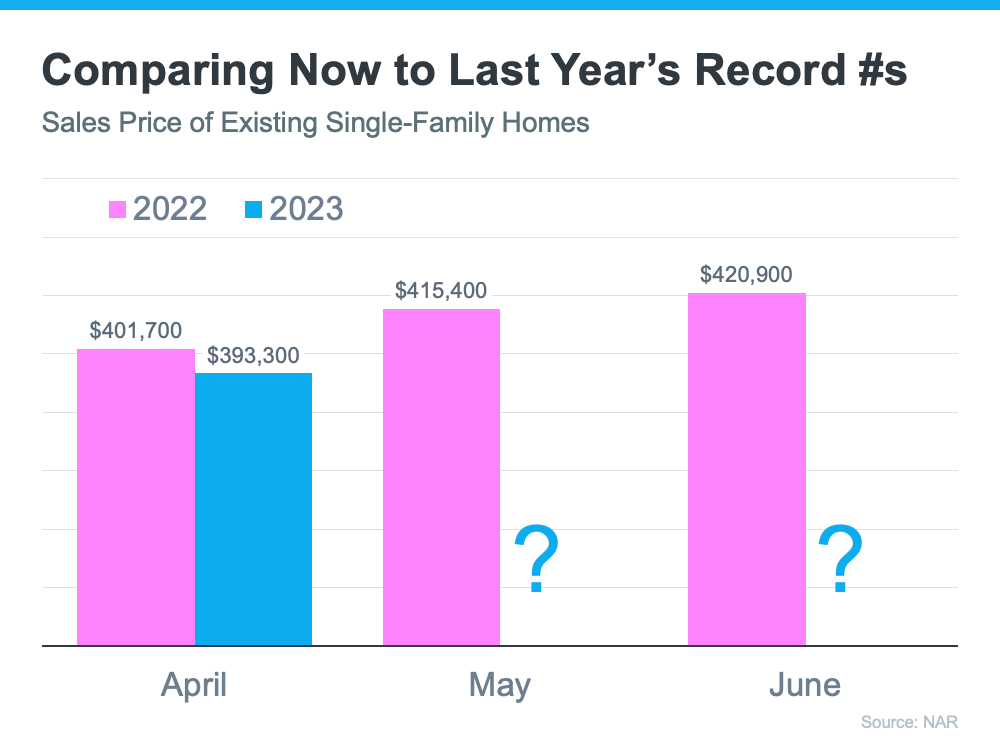
We’re about to enter a few months when home prices could possibly be lower than they were the same month last year. April, May, and June of 2022 were three of the best months for home prices in the history of the American housing market. Those same months this year might not measure up. That means, the Y-O-Y comparison will probably show values are depreciating. The numbers for April seem to suggest that’s what we’ll see in the months ahead (see graph below):

That’ll generate troubling headlines that say home values are falling. That’ll be accurate on a Y-O-Y basis. And, those headlines will lead many consumers to believe that home values are currently cascading downward.

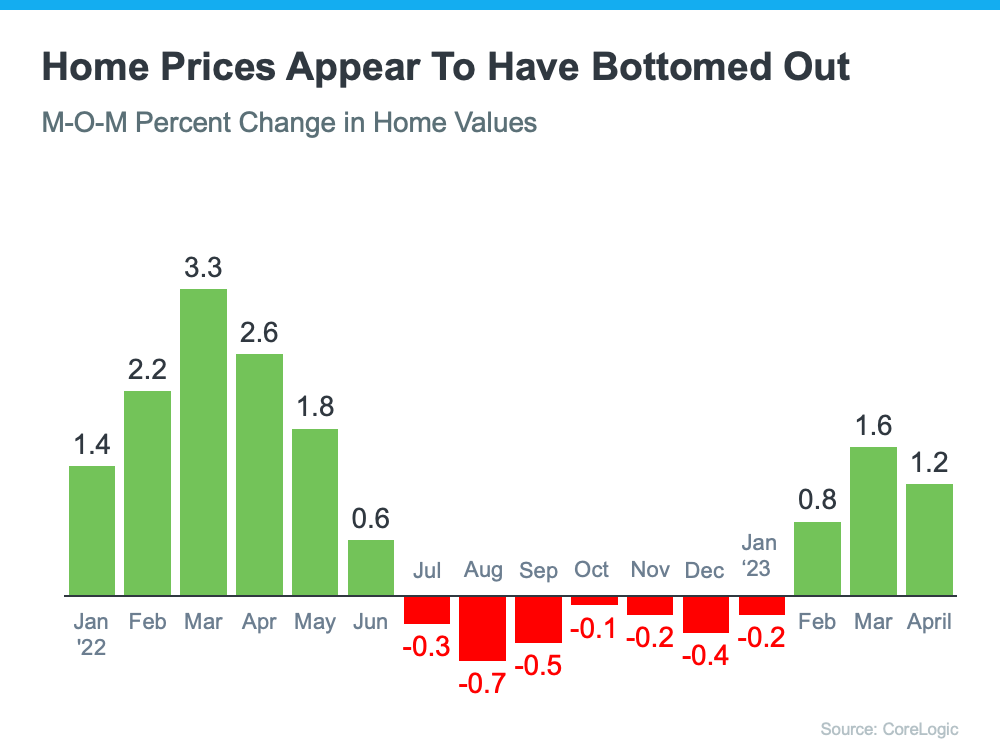
However, on a closer look at M-O-M home prices, we can see prices have actually been appreciating for the last several months. Those M-O-M numbers more accurately reflect what’s truly happening with home values: after several months of depreciation, it appears we’ve hit bottom and are bouncing back.

Here’s an example of M-O-M home price movements for the last 16 months from the CoreLogic Home Price Insights report (see graph below):

Why Does This Matter to You?

So, if you’re hearing negative headlines about home prices, remember they may not be painting the full picture. For the next few months, we’ll be comparing prices to last year’s record peak, and that may make the Y-O-Y comparison feel more negative. But, if we look at the more immediate, M-O-M trends, we can see home prices are actually on the way back up.

There’s an advantage to buying a home now. You’ll buy at a discount from last year’s price and before prices start to pick up even more momentum. It’s called “buying at the bottom,” and that’s a good thing.

Bottom Line

If you have questions about what’s happening with home prices, or if you’re ready to buy before prices climb higher, let’s connect.

Posted in Parker Real Estate
June 9, 2023

2023 Summer Seller's Guide

If you are thinking about selling your home this summer, you should definitely read this home seller guide.  It's absolutely the best, most comprehensive seller's guide that I have ever seen.  It's free. Simply fill in your name and email and it will be immediately sent to you.  By the way, we're just offering this as a way of offering you value.  We're not going to hassle you with phone calls.  If you want to visit with us, you can contact us.  Which would be awesome.  Bob Bustin 720.220.5058 or Cheryl Bustin 303.981.7339 Bob@BustinHOmeTeam.com.

Click here to download your 2023 Summer Seller's Guide


Posted in Parker Real Estate
June 8, 2023

Why Is The Real Estate Market So Strong?

WHY IS THE REAL ESTATE MARKET SO STRONG?  This is a very good article that explains the uniqueness of the market that makes it so strong.  The article goes into much more detail, but basically it credits the number of homeowners with historically low rates and those same homeowners with substantial equity.  I would agree.

This Real Estate Market Is the Strongest of Our Lifetime


When you look at the numbers today, the one thing that stands out is the strength of this housing market. We can see this is one of the most foundationally strong housing markets of our lifetime – if not the strongest housing market of our lifetime. Here are two fundamentals that prove this point. 

1. The Current Mortgage Rate on Existing Mortgages

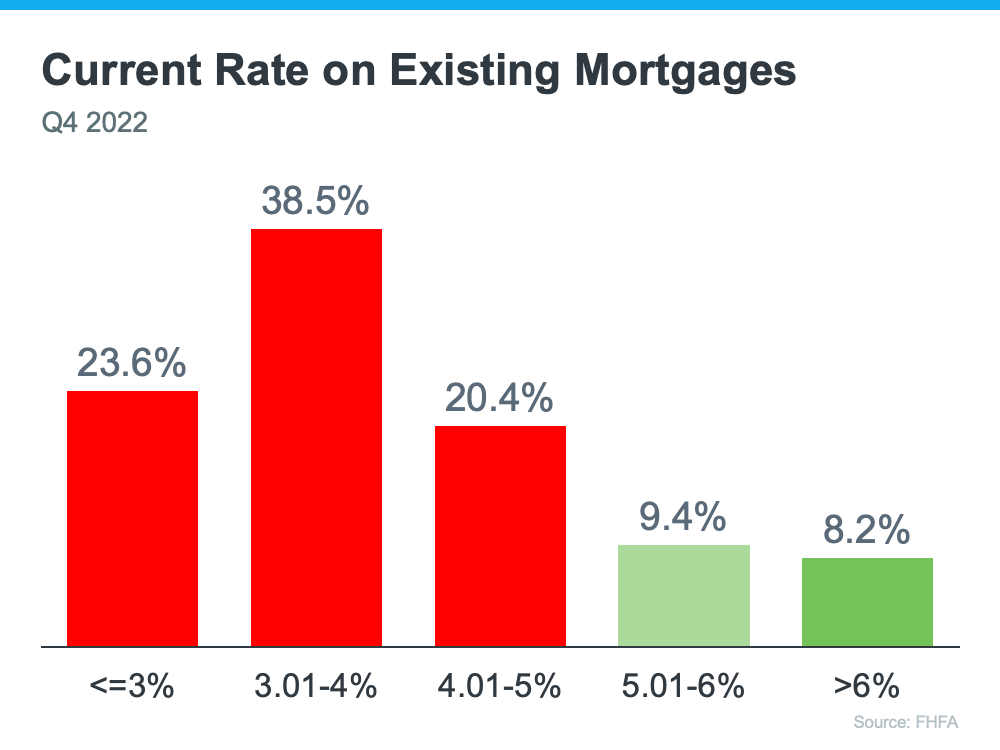
First, let’s look at the current rate on existing mortgages. According to the Federal Housing Finance Agency (FHFA), as of the fourth quarter of last year, over 80% of existing mortgages have a rate below 5%. That’s significant. And, to take that one step further, over 50% of mortgages have a rate below 4% (see graph below):

Now, there’s a lot of talk in the media about a potential foreclosure crisis or a rise of homeowners defaulting on their loans, but consider this. Homeowners with such good mortgage rates are going to work as hard as they can to keep that mortgage and stay in their homes. That’s because they can't go out and buy another house, or even rent an apartment, and pay what they do today. Their current mortgage payment is more affordable. Even if they downsize, with today’s higher mortgage rates, it could cost more.

Here's why this gives the housing market such a solid foundation today. Having so many homeowners with such low mortgage rates helps us avoid a crisis with a flood of foreclosures coming to market like there was back in 2008.

2. The Amount of Homeowner Equity

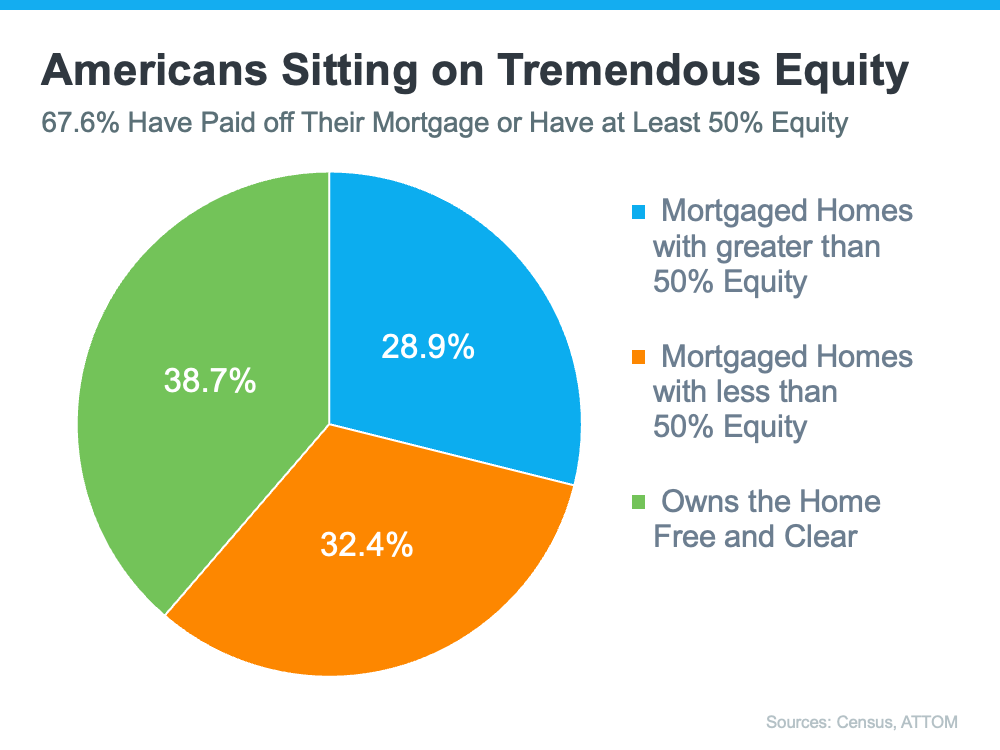
Second, Americans are sitting on tremendous equity right now. According to the Census and ATTOM, roughly two-thirds (around 68%) of homeowners have either paid off their mortgage or have at least 50% equity (see chart below):

In the industry, the term for this is equity rich. This is significant because if you think back to 2008, some people had to make the difficult decision to walk away from their homes because they owed more on the home than it was worth.

But this time, things are different because homeowners have built up so much equity over the past few years alone. And, when homeowners have that much equity, it helps us avoid another wave of distressed properties coming onto the market like we saw during the crash. It also creates an extremely strong foundation for today’s housing market.

Bottom Line

We are in one of the most foundationally strong housing markets of our lifetime because homeowners are going to fight to keep their current mortgage rate and they have a tremendous amount of equity. This is yet another reason things are fundamentally different than in 2008.


Posted in Parker Real Estate
June 7, 2023

Why Are Mortgage Rates So High

WHY ARE MORTGAGE RATES SO HIGH?

I really don't have anything to add to this article.  It's very detailed and presents a very accurate picture of where rates are and what they might do over the remainder of the year.  Regardless of what rates do in the future, it's time to buy today.  If rates go down, refinance.  If they continue to go up, be glad you acted today.

The Main Reason Mortgage Rates Are So High


Today’s mortgage rates are top-of-mind for many homebuyers right now. As a result, if you’re thinking about buying for the first time or selling your current house to move into a home that better fits your needs, you may be asking yourself these two questions: 

  1. Why Are Mortgage Rates So High?
  2. When Will Rates Go Back Down?

Here’s context you need to help answer those questions.

1. Why Are Mortgage Rates So High? 

The 30-year fixed-rate mortgage is largely influenced by the supply and demand for mortgage-backed securities (MBS). According to Investopedia

“Mortgage-backed securities (MBS) are investment products similar to bonds. Each MBS consists of a bundle of home loans and other real estate debt bought from the banks that issued them . . . The investor who buys a mortgage-backed security is essentially lending money to home buyers.”

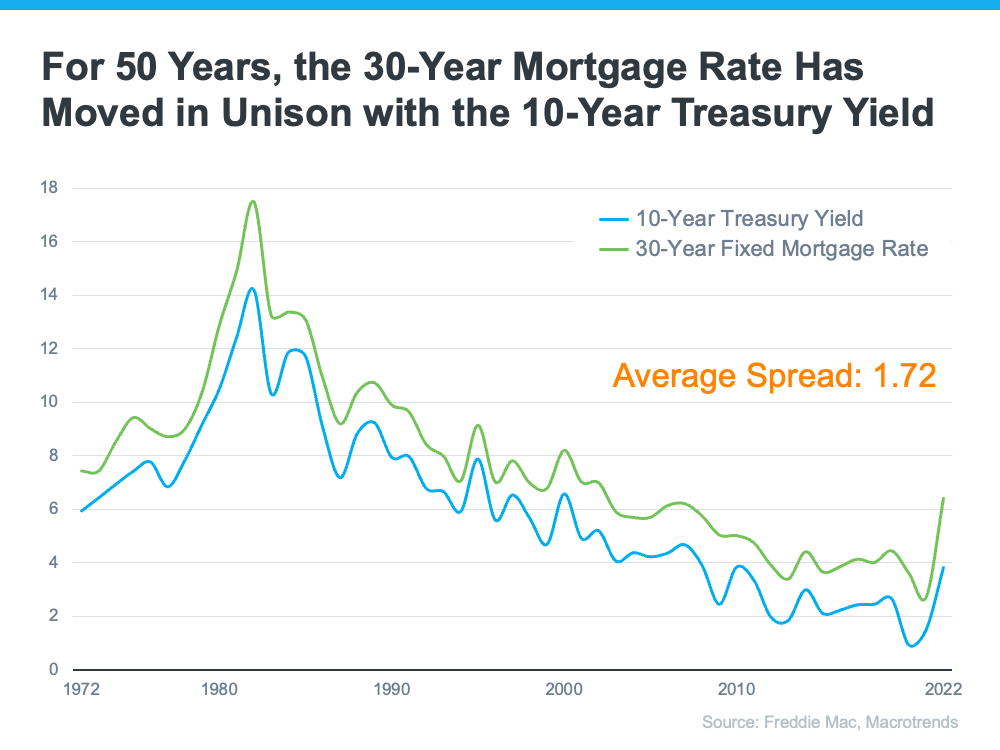
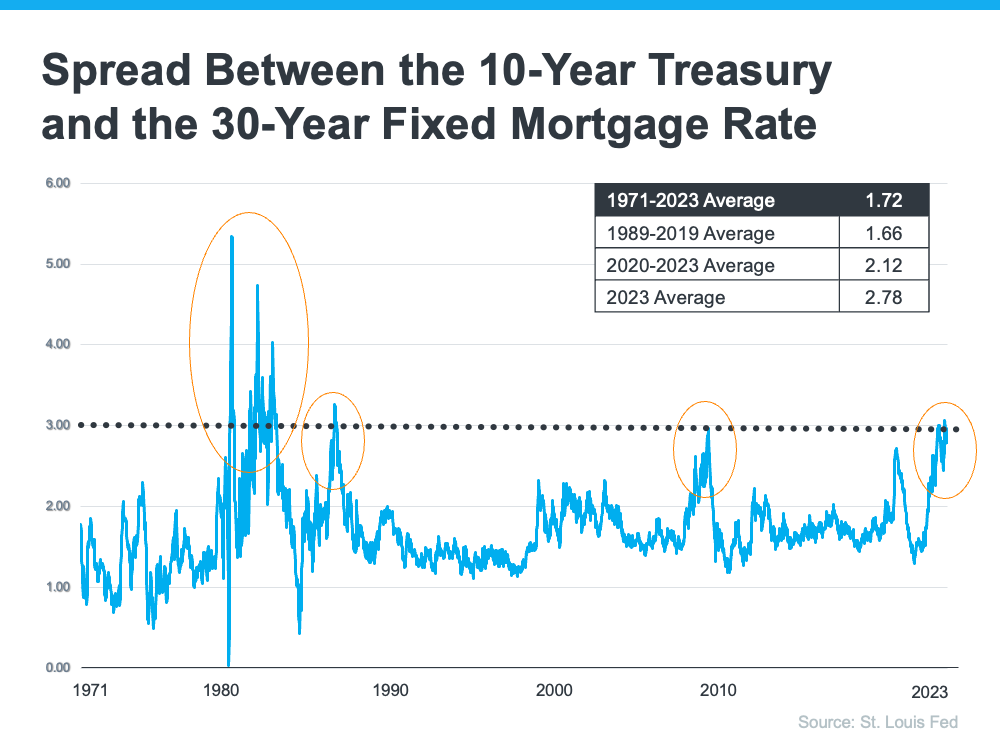
Demand for MBS helps determine the spread between the 10-Year Treasury Yield and the 30-year fixed mortgage rate. Historically, the average spread between the two is 1.72 (see chart below):

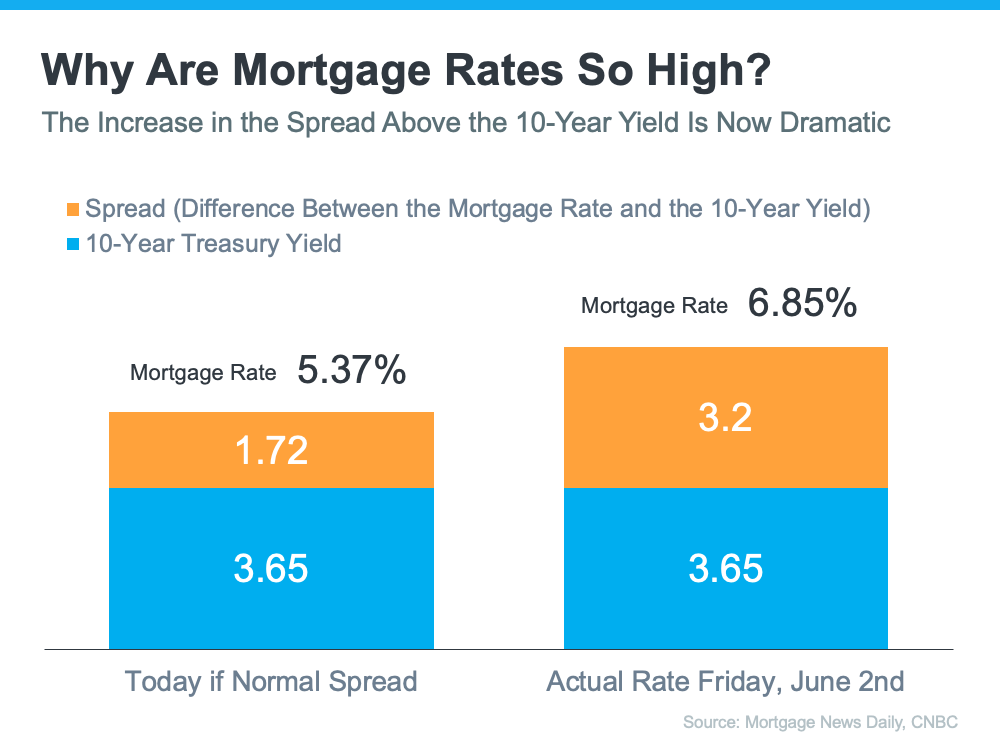
Last Friday morning, the mortgage rate was 6.85%. That means the spread was 3.2%, which is almost 1.5% over the norm. If the spread was at its historical average, mortgage rates would be 5.37% (3.65% 10-Year Treasury Yield + 1.72 spread).

This large spread is very unusual. As George Ratiu, Chief Economist at Keeping Current Matters (KCM), explains:

“The only times the spread approached or exceeded 300 basis points were during periods of high inflation or economic volatility, like those seen in the early 1980s or the Great Financial Crisis of 2008-09."

The graph below uses historical data to help illustrate this point by showing the few times the spread has increased to 300 basis points or more:

The graph shows how the spread has come down after each peak. The good news is, that means there’s room for mortgage rates to improve today.

So, what’s causing the larger spread and making mortgage rates so high today?

The demand for MBS is heavily influenced by the risks associated with investing in them. Today, that risk is impacted by broader market conditions like inflation and fear of a potential recession, the Fed’s interest rate hikes to try to bring down inflation, headlines that create unnecessarily negative narratives about home prices, and more.

Simply put: when there’s less risk, demand for MBS is high, so mortgage rates will be lower. On the other hand, if there’s more risk with MBS, demand for MBS will be low, and we’ll see higher mortgage rates as a result. Currently, demand for MBS is low, so mortgage rates are high.

2. When Will Rates Go Back Down?

Odeta Kushi, Deputy Chief Economist at First American, answers that question in a recent blog:

“It’s reasonable to assume that the spread and, therefore, mortgage rates will retreat in the second half of the year if the Fed takes its foot off the monetary tightening pedal and provides investors with more certainty. However, it’s unlikely that the spread will return to its historical average of 170 basis points, as some risks are here to stay.”

Bottom Line

The spread will shrink when the fear investors feel is eased. That’ll mean we should see mortgage rates moderate as the year goes on. However, when it comes to forecasting mortgage rates, no one can know for sure exactly what will happen.

Posted in Parker Real Estate
June 6, 2023

Is Real Estate The Best Long Term Investment

Is real estate the best long term investment.  In my opinion, it is, without a doubt.  I can only go by my personal experience and the facts that are available to anyone interested.  I got started in the mortgage business in Houston, Texas in 1975.  One year before Cheryl Miller Bustin​ and I were married.  Our first home was a 1 bedroom apartment, but being in the mortgage business, I was totally involved in real estate.  At the time, tract homes ( like Richmond, Lennar, DR Horton, etc.) were selling for around $50,000.  Those homes today, in the Houston Metro Area, are valued at $350,000 to $500,000.  That's pretty impressive. I do realize that much larger returns have been achieved in the stock market.  And, if someone invested $50,000, 50 years ago in a savings account, it might be more.  But, here's the difference.  And it's a major difference.  It's your home.  It's where you live.  It's tangible.  Oh, let's not forget the savings in income tax over those 50 years.  When it's all said and done, the return on the home is probably the greatest.


Another example, would be home appreciation over the last 10 years.  I understand that we live in a "hot' market here in Colorado.  But, our home (and most people's homes) have doubled in value over the last 10 years.  A $250,000 home is now worth $500,000.  A $400,000 home is now worth $800,000.  The higher you go up in value, the less percentage increase.  But, all homes have seen great price increases.  For many of us, it's dramatically increased out net worth, and changed our future financial outlook.


So, bottom line.  Buy now.  And, buy as much as you can and are comfortable with.  In the long run, you will be so glad you did.

Real Estate Is Still Considered the Best Long-Term Investment


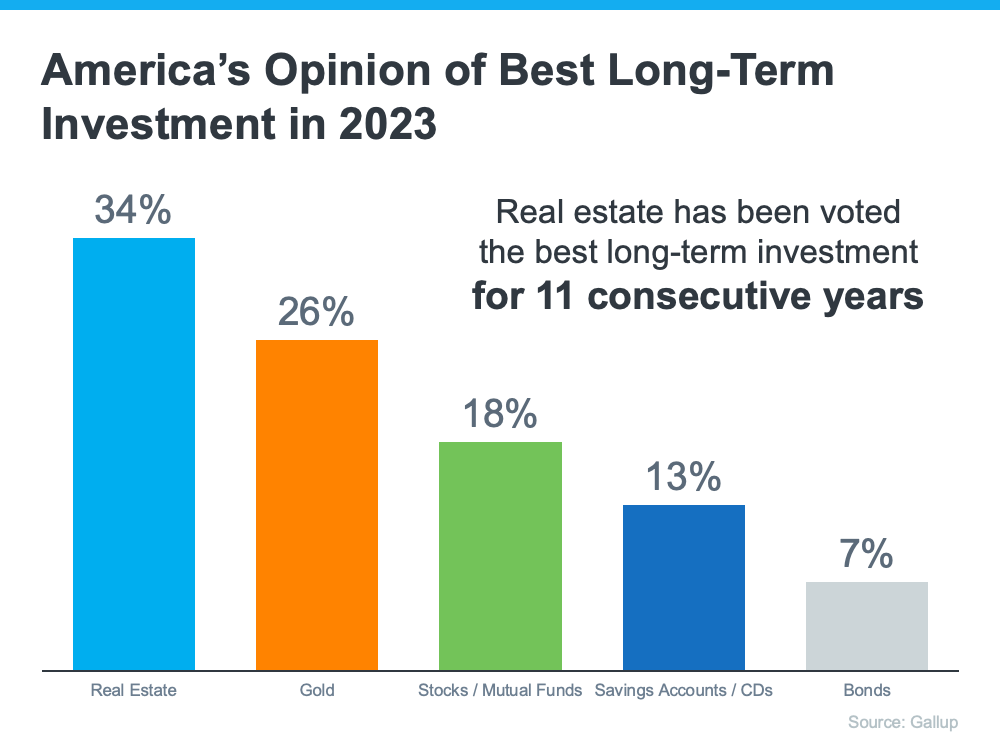
With all the headlines circulating about home prices and rising mortgage rates, you may wonder if it still makes sense to invest in homeownership right now. A recent poll from Gallup shows the answer is yes. In fact, real estate was voted the best long-term investment for the 11th consecutive year, consistently beating other investment types like gold, stocks, and bonds (see graph below):

If you’re thinking about purchasing a home, let this poll reassure you. Even with everything happening today, Americans recognize owning a home is a powerful financial decision.

Why Do Americans Still Feel So Positive About the Value of Investing in a Home?

Purchasing real estate has typically been a solid long-term strategy for building wealth in America. As Lawrence Yun, Chief Economist at the National Association of Realtors (NAR), notes:

“. . . homeownership is a catalyst for building wealth for people from all walks of life. A monthly mortgage payment is often considered a forced savings account that helps homeowners build a net worth about 40 times higher than that of a renter.”

That’s because owning a home grows your net worth over time as your home appreciates in value and as you pay down your mortgage. And, since building that wealth takes time, it may make sense to start as soon as you can. If you wait to buy and keep renting, you’ll miss out on those monthly housing payments going toward your home equity.

Bottom Line

Buying a home is a powerful decision. So, it’s no wonder so many people view real estate as the best long-term investment. If you’re ready to start on your own journey toward homeownership, let’s connect today.


Posted in Parker Real Estate
June 5, 2023

Home Prices Have Not Come Down

This is a very good article regarding what has happened to home prices over the last several months.  Basically, what it's saying is, contrary to popular belief (from those pundits NOT on the ground), home prices have remained steady.  And, now are showing signs of future increases.

I noted "those pundits NOT on the ground" in my remarks.  That's because over the years, it's been my experience that those pundits are almost always wrong.  I experienced it in my mortgage career and now in real estate.  This bad information that we continually deal with impacts the decisions of our clients.  I can't tell you how many of our clients have lost money over the last year, because they were waiting on home prices to fall.  Based on information from the pundits.  And, many times their friends and acquaintances.  All the while, listening to us tell them to not wait.  We can certainly be wrong.  I hope that doesn't happen, but of course, it's possible.  But, I still maintain, based on being 'in the thick of it" for over 45 years, that we are not going to see a drop in home prices.  Too much demand and not enough inventory.  And, even if interest rates remain at today's levels, people will eventually adjust to the rates and move on.  People can rent or they can buy.  Buying is the best option.

Oops! Home Prices Didn’t Crash After All


During the fourth quarter of last year, many housing experts predicted home prices were going to crash this year. Here are a few of those forecasts:

Jeremy Siegel, Russell E. Palmer Professor Emeritus of Finance at the Wharton School of Business:

“I expect housing prices fall 10% to 15%, and the housing prices are accelerating on the downside.”

Mark Zandi, Chief Economist at Moody’s Analytics:

"Buckle in. Assuming rates remain near their current 6.5% and the economy skirts recession, then national house prices will fall almost 10% peak-to-trough. Most of those declines will happen sooner rather than later. And house prices will fall 20% if there is a typical recession.” 

Goldman Sachs

“Housing is already cooling in the U.S., according to July data that was reported last week. As interest rates climb steadily higher, Goldman Sachs Research’s G-10 home price model suggests home prices will decline by around 5% to 10% from the peak in the U.S. . . . Economists at Goldman Sachs Research say there are risks that housing markets could decline more than their model suggests.”

The Bad News: It Rattled Consumer Confidence

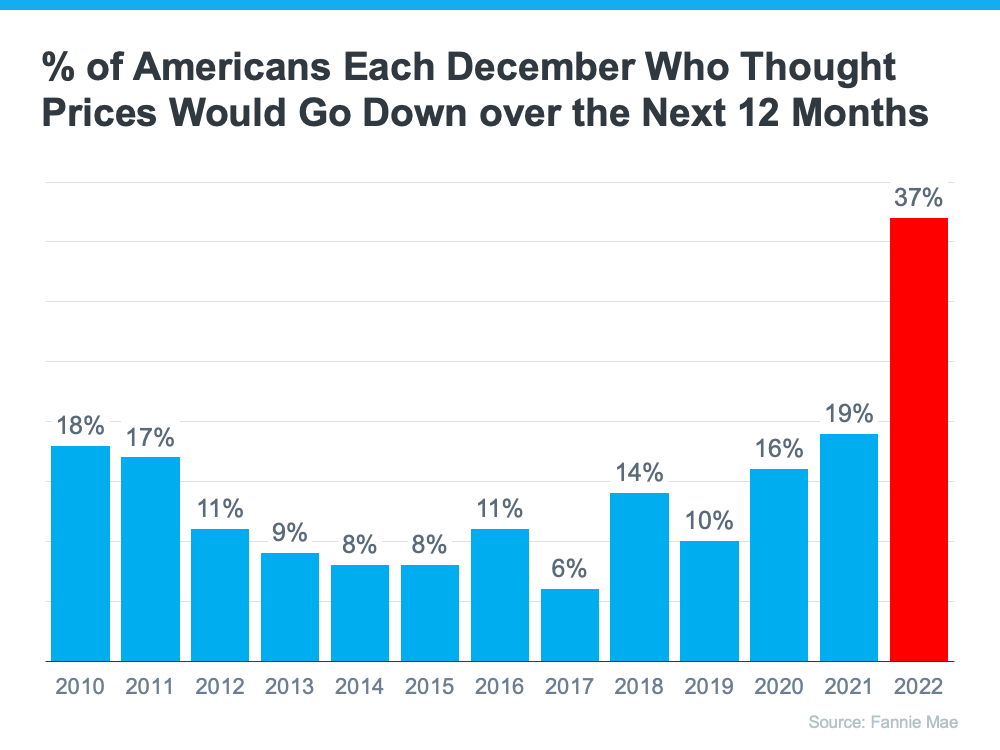
These forecasts put doubt in the minds of many consumers about the strength of the residential real estate market. Evidence of this can be seen in the December Consumer Confidence Survey from Fannie Mae. It showed a larger percentage of Americans believed home prices would fall over the next 12 months than in any other December in the history of the survey (see graph below). That caused people to hesitate about their homebuying or selling plans as we entered the new year.

The Good News: Home Prices Never Crashed

However, home prices didn’t come crashing down and seem to be already rebounding from the minimal depreciation experienced over the last several months. 

In a report just released, Goldman Sachs explained:

“The global housing market seems to be stabilizing faster than expected despite months of rising mortgage rates, according to Goldman Sachs Research. House prices are defying expectations and are rising in major economies such as the U.S.,. . . ”

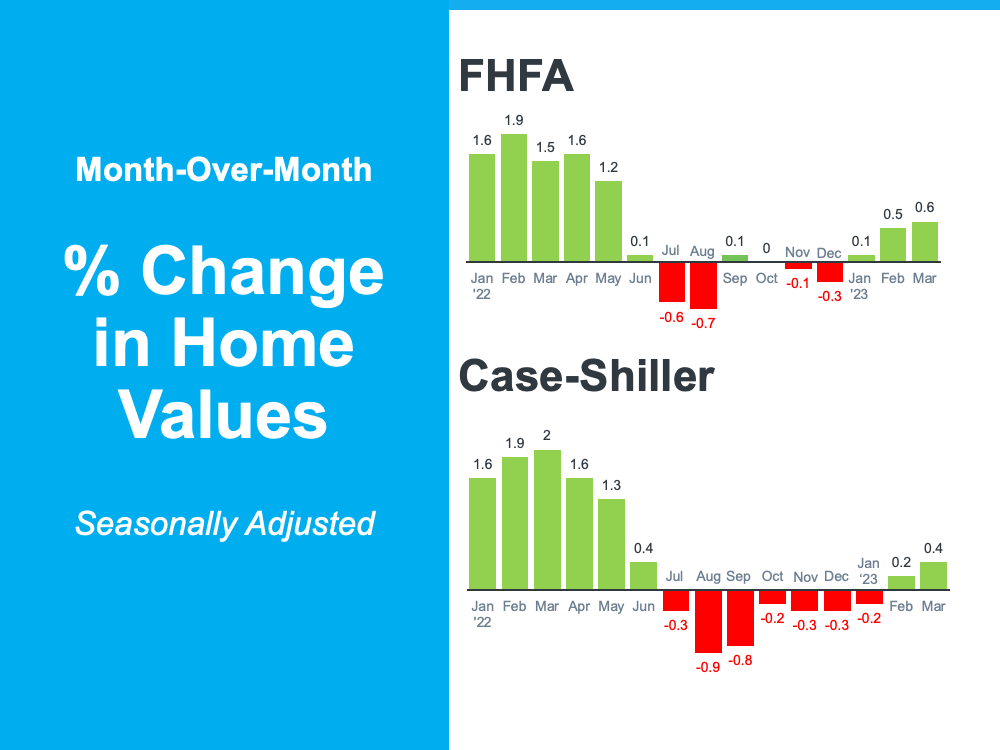
Those claims from Goldman Sachs were verified by the release last week of two indexes on home prices: Case-Shiller and the FHFA. Here are the numbers each reported:

Home values seem to have turned the corner and are headed back up.

Bottom Line

When the forecasts of significant home price appreciation were made last fall, they were made with megaphones. Mass media outlets, industry newspapers, and podcasts all broadcasted the news of an eminent crash in prices.

Now, forecasters are saying the worst is over and it wasn’t anywhere near as bad as they originally projected. However, they are whispering the news instead of using megaphones. As real estate professionals, it is our responsibility – some may say duty – to correct this narrative in the minds of the American consumer.

Posted in Parker Real Estate
May 31, 2023

New Way For 1st Time Homebuyers to Buy A Home

This is an article targeted to first time homebuyers.  It has some good information.  But, honestly, nothing new that makes a difference.  I, on the other hand, have an ideal that I've believed in for years.  It's the concept of two first time homeowners purchasing a home together.  When I was in college and several years after college, I roomed with two other men that I had actually gone to elementary school, through college and beyond.  We lived together, in Austin, for over 6 years.  Each of us moved out, as we got married.  Three guys in one house.  It was awesome.  My regret, however, is that we never thought about buying a house, rather than renting.  And, after college, all of us had good paying jobs that would have allowed us to buy a very nice home.  We could have jointly kept the house, long term.  We could have sold it and divided the equity.  


I think young, single adults should consider this option.  The average home here in Parker and Castle Rock is $550,000 to $700,000.  How many single adults, making great money, can afford a home in this price range,  Very few.  But, what if two first time homeowners were to consider the same homes?  They absolutely could afford one of these or even higher.  And, the difference between a $700,000 house and a $350,000 condo is drastic.  Who wouldn't rather live in a 3500 square feet home with a 3 car garage and yard, than a 800 square feet condo with no yard and no garage.  It's a great idea for current living and future return on your investment.

Keys to Success for First-Time Homebuyers



Buying your first home is an exciting decision and a major milestone that has the power to change your life for the better. As a first-time homebuyer, it’s a vision you can bring to life, but, as the National Association of Realtors (NAR) shares, you’ll have to overcome some factors that have made it more challenging in recent years:


“Since 2011, the share of first-time home buyers has been under the historical norm of 40% as buyers face tight inventory, rising home prices, rising rents and high student debt loads.”

That said, if you’re looking to purchase your first home, here are two things you can consider to help make your dreams a reality.

Save Money with First-Time Homebuyer Programs

Being able to pay for the initial costs and fees associated with homeownership can feel like a major hurdle. Whether that’s getting a loan, being able to put together a down payment, or having money for closing costs – there are a variety of expenses that can make buying your first home feel challenging

Fortunately, there are a lot of public and private first-time homebuyer programs that can help you get a loan with little-to-no money upfront. CNET explains:


A first-time homebuyer program can help make homeownership more affordable and accessible by offering lower mortgage rates, down payment assistance and tax incentives.” 

In fact, as Bankrate says, many of these programs are offered by state and local governments:


Many states and local governments have programs that offer down payment or closing cost assistance – either low-interest-rate loans, deferred loans or even forgivable loans (aka grants) – to people looking to buy their first house . . .” 

To take advantage of these programs, contact the housing authority in your state and browse sites like Down Payment Resource.

The Supply of Homes for Sale Is Low, So Explore Every Possibility

It’s a sellers’ market, meaning there aren’t enough homes on the market to meet buyer demand. So, how can you be sure you’re doing everything you can to find a home that works for you? You can increase your options by considering condominiums (condos) and townhomes. U.S. News tells us these housing types are often less expensive than single-family homes:


Condos are usually less expensive than standalone houses . . . They are also less expensive to insure.”

One reason why they may be more affordable is because they’re often smaller. But they still give you the chance to get your foot in the door and achieve your dream of owning and building equity. Beyond that, another major perk is they typically require less maintenance. As U.S. News says in the same article:


The strongest reason for purchasing a condo is that all external maintenance is usually covered by the condo association, such as landscaping, pool maintenance, external painting, paving, plowing and more. This fee also covers some internal maintenance, such as gas, electric, plumbing, HVAC and other mechanical systems.” 

Townhomes and condos are great ways to get into homeownership. Owning your home allows you to build equity, increase your net worth, and can fuel a future move.

The best way to make sure you’re set up for success, especially if you’re just starting out, is to work with a trusted real estate agent. They can educate you on the homebuying process, help you understand your local area to find options that are right for you, and coach you through making an offer in a competitive market.

Bottom Line

Today’s housing market provides some challenges for first-time homebuyers. But, there are still ways to achieve your goals, like utilizing first-time homebuyer programs and considering all of your housing options. Let’s connect so you have an expert on your side who can help you navigate the process.

Posted in Parker Real Estate